


Laser Tattoo Removal Treatment Specialist in Canton, MI
Check Out Our Before And After Photos of Real Clients at Prime Skin & Laser Med Spa
Table of Contents:
How does laser tattoo removal work?
Will laser treatments completely remove my tattoo?
What can I expect during the laser tattoo removal?
What kind of after-care should I expect if I have laser tattoo removal?
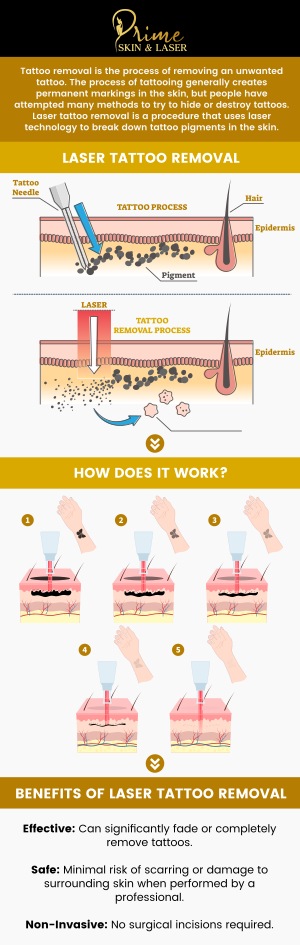
Laser tattoo removal is a non-invasive procedure that uses a laser to break down the pigments in tattoos, causing them to fade or disappear altogether. The removal process involves targeting the pigment with a laser, which breaks it down into smaller molecules and causes it to eventually fade. The procedure is completely painless, and many people experience little to no discomfort at all over the course of the day. The full process can take from a few days to a few weeks, depending on how large the tattoo is and how much of it needs to be removed.
How does laser tattoo removal work?
Laser tattoo removal works by using an intense beam of light to destroy the pigment in the skin, which breaks down the tattoo ink into smaller particles. The tattoo ink is broken down into particles so small that they can be absorbed by white blood cells. The ink particles are absorbed by the white blood cells for the purpose of transportation to the liver, where they will be processed and eliminated from the body. In order to break up the ink into smaller particles, it must be heated up until it expands due to thermal expansion; however, the laser pulse must be quick enough so that half of the particle remains cool. This is necessary as the opposing hot and cold forces separate the ink into smaller fragments, which can then be absorbed by the white blood cells.
Will laser treatments completely remove my tattoo?
The results of a laser tattoo removal treatment depend on the specific circumstances unique to each situation, including:
• The area of the tattoo
• The size of the tattoo
• The color of the tattoo
For small or light-colored tattoos, laser tattoo removal can achieve great results, often completely removing the pigment of the tattoo. However, for large or dark-colored tattoos, the laser may only be able to fade the tattoo. In situations like these, patients often opt to receive another tattoo in the same area in order to cover up the leftover pigment. This can effectively eliminate the previous tattoo as the new pigment covers the leftover pigment.


 Send Text
 How May I Help You?
